CSIR’s Kolkata RISE Conclave Connects Four Labs With Industry
The September 6–7 programme linked minerals, medicine, materials and machinery. Its reported transfer initiatives need to be followed through to licensing, validation and production.
Manik Gupta
Founder and editor of DeepTech India. Manik writes about India's frontier technology ecosystem — AI, semiconductors, space, quantum, robotics and biotech — translating research and policy into clear, reliable reporting.
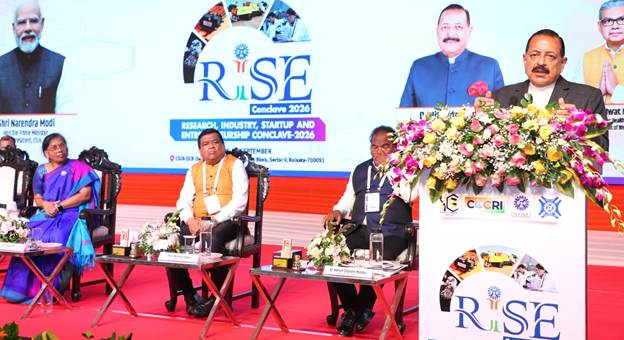
Four CSIR laboratories brought their technologies to the same industry-facing programme in Kolkata on September 6–7. The sixth RISE Conclave, hosted at CSIR-IICB in Salt Lake, brought together CGCRI, IICB, CMERI and IMMT around minerals, medicine, materials and machines.
The Science and Technology Ministry’s September 6 account listed eight MoUs, four technology-transfer initiatives, two product launches and a facility inauguration as parts of the programme. It reported around 150 startups taking part.
Those figures describe the event’s announced activities. They do not demonstrate that every transfer has completed industrial validation or produced commercial sales.
Getting beyond the meeting
For a prospective licensee, the useful output is a package that can be evaluated: what the technology does, how it was tested, what remains to be engineered and what the licence covers. A transfer announcement without those details makes it difficult to distinguish a production-ready process from a promising laboratory result.
The four-lab format could help an enterprise examine connected problems across disciplines. But proximity is an opportunity, not evidence that a particular joint product or venture has emerged. The next reporting should identify individual technologies and follow their recipients.
Keep the financing mechanisms distinct
The ministry’s release referred to the ₹1 lakh crore Research, Development and Innovation Fund and separately to ANRF’s role. That does not make RISE a funding scheme, nor does it make the fund’s entire outlay money available to attendees.
Why it matters
The practical test is whether the announced relationships survive the work after the event. For each technology-transfer initiative, a useful follow-up would establish the receiving company, licensing status, validation plan and first manufacturing milestone.
That record would be more informative than repeating an event-wide MoU count. It would also make the limits visible: a signed partnership can be valuable while still requiring substantial development before customers can use the technology.
Image: Jitendra Singh at the Kolkata RISE Conclave, from the ministry’s release.
Tags
More from Miscellaneous
Four Indian Ventures Join Google DeepMind’s AI for the Planet Cohort
Terrastack, Varaha Climate, Farmers for Forests and Climitra Carbon join the APAC programme, announced on 7 September.
India Endorses Global 6G Coordination and Security Initiative
DoT will coordinate India’s participation in the September 9 announcement. The pledge defines staged follow-up while preserving national positions in standards bodies.