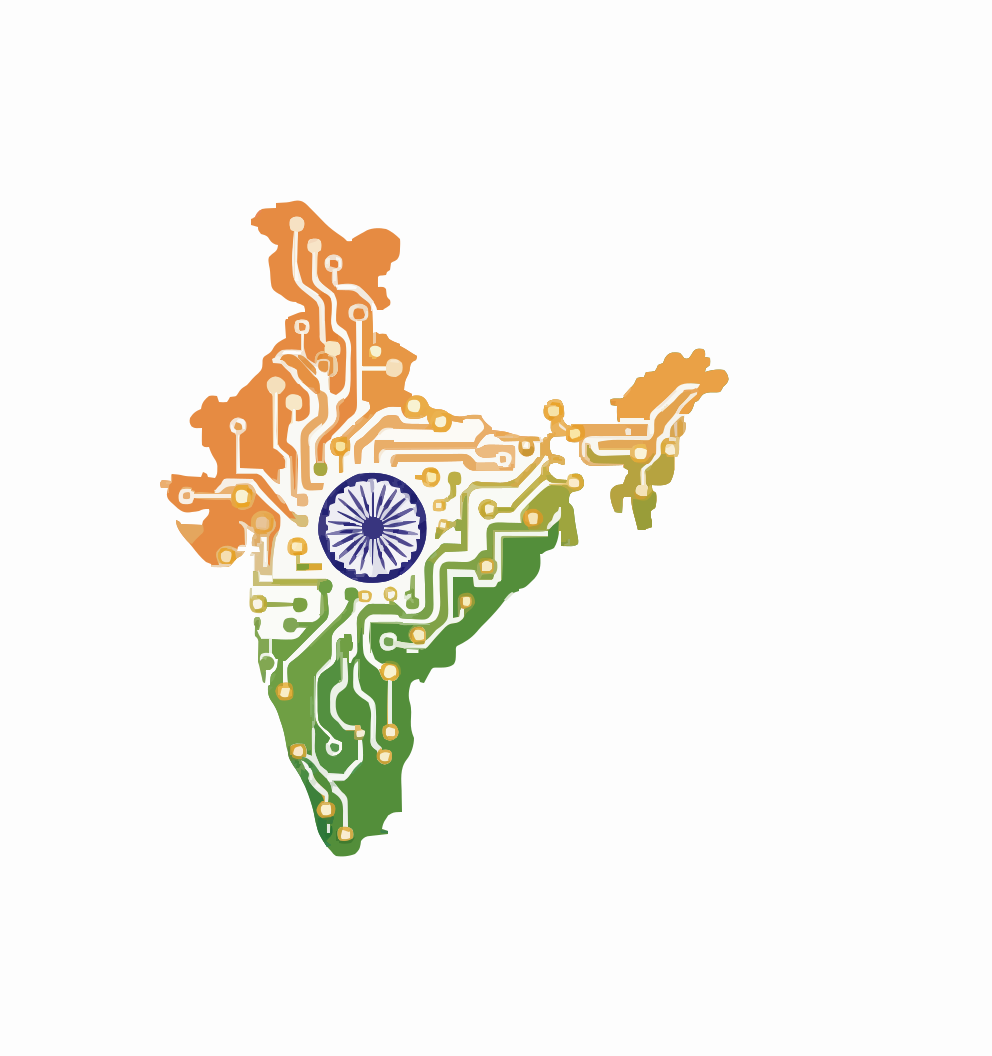
'Nanotech's Next Frontier': Bengaluru India Nano 2026 Puts AI at the Centre
The 14th Bengaluru India Nano summit (3–5 August 2026), inaugurated by Karnataka Deputy CM D.K. Shivakumar, gathered 80-plus speakers from over 10 countries around the theme of AI-accelerated nanotech and commercialisation across semiconductors, energy and health.
/ciol/media/media_files/2026/08/04/dks-2026-08-04-14-47-02.png)
India's flagship nanotechnology gathering, Bengaluru India Nano 2026, returned for its 14th edition from 3 to 5 August 2026, drawing scientists, industry and policymakers to the city that has anchored the event for well over a decade. Karnataka Deputy Chief Minister D.K. Shivakumar inaugurated the main conference on 4 August.
A convening with a theme for the moment
This year's edition carried the theme "Nanotech's Next Frontier: AI & Beyond — Conceive, Converge, Commercialize." The framing is telling: nanotechnology, long a field of patient materials science, is increasingly entangled with artificial intelligence — both as a tool for discovering and designing new nanomaterials, and as a domain that nanoscale devices (sensors, memory, photonics) will help power.
The programme was organised around three application tracks that map neatly onto India's strategic priorities:
- Nano in Semiconductors — nanoscale fabrication and materials for the chips at the heart of India's semiconductor mission;
- Nano in Energy & Environment — nanomaterials for batteries, catalysis, solar and water;
- Nano in Agriculture & Health — nano-fertilisers, nano-formulations and nanomedicine.
More than 80 speakers from over 10 countries participated across the three days, alongside an exhibition floor bringing together research institutions and companies.
The organisers, and a legacy
The event is run by the Karnataka Department of Science & Technology, the Karnataka Science and Technology Promotion Society (KSTePS) and the Jawaharlal Nehru Centre for Advanced Scientific Research (JNCASR). Karnataka's IT-BT minister Priyank Kharge was among those attending.
Bengaluru India Nano owes much of its stature to Prof. C.N.R. Rao, the Bharat Ratna-winning chemist and honorary president of JNCASR, who has been the intellectual force behind India's nanoscience push for a generation. The conference he helped establish has become the country's principal meeting point for the field — the place where academic groups, startups and government funders take stock of where India's nanotechnology stands.
From lab to commercialisation
The recurring word in this year's theme — "Commercialize" — points to the field's central Indian challenge. India has strong nanoscience research, with world-class groups at JNCASR, the IITs, IISc and national labs producing high-quality work on graphene, nanomaterials and nanomedicine. Translating that into products, companies and manufacturing has been slower.
That is why the summit's tracks matter beyond the talks. Nano-enabled materials sit upstream of several of India's biggest deep-tech bets: better anode and cathode materials for domestic battery cells; nanoscale patterning and novel materials for semiconductor packaging; nano-formulated drugs and diagnostics for affordable healthcare. A convening that pulls researchers, chip and battery makers, and funders into the same halls is, in effect, an attempt to shorten the distance from paper to product.
Why it matters for India's deep-tech push
Nanotechnology rarely makes headlines the way rockets or AI models do, but it is quietly foundational. Nanomaterials and nanofabrication underpin advances in energy storage, electronics, sensing and medicine — the very sectors that dominate India's frontier-technology agenda. A healthy, well-attended national forum, with global participation and explicit industry tracks, is a leading indicator of whether that foundational layer is maturing.
The real test, as ever, will be what emerges in the months after the halls empty: the collaborations struck, the startups funded, and the materials that make it out of the lab and into a factory. But by anchoring this year's conversation around AI-accelerated discovery and commercialisation, Bengaluru India Nano 2026 has at least pointed the field at the right questions.
Sources
- ANI — "Karnataka CM D.K. Shivakumar inaugurates India Nano 2026 conference in Bengaluru": https://www.aninews.in/news/national/general-news/karnataka-cm-dk-shivakumar-inaugurates-india-nano-2026-conference-in-bengaluru20260804142135/
- The Hans India — "Bengaluru India Nano 2026 concludes after 3-day nanotech discussions": https://www.thehansindia.com/bengaluru/bengaluru-india-nano-2026-concludes-after-3-day-nanotech-discussions-1105710
- YourStory — Bengaluru India Nano 2026 coverage: https://yourstory.com/2026/08/bengaluru-india-nano-2026-ai-nanotechnology
- Official event site: https://www.bengaluruindianano.in/