
Balrampur’s PLA Pilot Targets the Gap Between Biopolymer Research and Factory Production
A planned 100-tonne-a-year R&D facility in Uttar Pradesh will develop specialised PLA grades and co-polymers, generate process data and support customer validation.
Manik Gupta
Founder and editor of DeepTech India. Manik writes about India's frontier technology ecosystem — AI, semiconductors, space, quantum, robotics and biotech — translating research and policy into clear, reliable reporting.
Coverage date: 24 September 2026. Published as part of our 20–25 September catch-up.
Balrampur Chini Mills' proposed 100-tonne-per-year pilot facility at Kumbhi, Uttar Pradesh, will focus on specialised polylactic acid grades and advanced PLA co-polymers. Its task is to develop materials and process knowledge that can move beyond laboratory preparation into validated manufacturing.
The Department of Biotechnology described the initiative on 24 September as part of the BioE3 programme. BIRAC is supporting the pilot-scale R&D facility with a Rs 75 crore grant. The technical programme, rather than the grant alone, is the significant part: product development, customer validation and generation of techno-economic data for scale-up.
Two scales that should not be confused
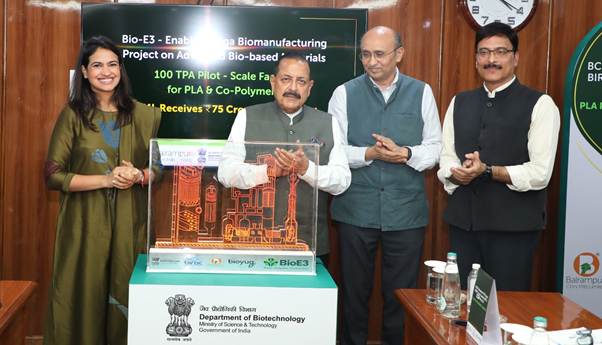
The announcement formally launched the commercial use of bio-based biodegradable plastic based on PLA. It separately says the 100 TPA pilot facility will be established at BCML's integrated Kumbhi complex. A launch event therefore does not establish that this particular pilot plant is already operating at its proposed annual capacity.
The pilot is also distinct from the company's industrial-scale commercial PLA venture. Its role is to investigate next-generation grades and co-polymers, support technology indigenisation and produce information needed for commercial production. Reporting the pilot's 100 TPA figure as the capacity of the entire commercial venture would collapse two different projects into one.
Why a pilot plant matters
The stated work connects renewable sugar-based feedstock with lactic acid and higher-value biopolymers. The release identifies specialised materials and customer validation as intended outputs, rather than presenting PLA as one interchangeable replacement for every conventional plastic.
Pilot-scale work provides a place to connect product requirements with process choices. For this project, the government explicitly identifies process know-how and techno-economic data as deliverables. Those results will be more informative than a capacity headline: they can show which grades are feasible to make and what further development is needed before scale-up.
The evidence still needed
The release does not provide grade-specific performance data, customer qualification results or the operating results of the planned pilot. It also does not specify disposal conditions or a degradation test for each proposed product. Its biodegradable description should not be read as proof that every final article will rapidly disappear in any environment.
A useful next milestone is an operating pilot accompanied by independently assessable material specifications, process performance and application-specific validation. The programme's importance lies in trying to build that bridge between biopolymer research and industrial use. Whether it succeeds will be determined by those outputs, not by the ceremonial launch alone.
Source and image
Department of Biotechnology announcement, 24 September 2026. The official photograph shows the launch and a display model, not a commissioned manufacturing line. Image: Department of Biotechnology / PIB, reproduced with attribution under the PIB copyright policy.
Tags
More from Advanced Materials
India Photonics Association Launches to Connect Research and Industry
The new industry body aims to build collaboration across optical technologies, supply chains and policymaking.
JNCASR and IISc Scientists Shatter a Century-Old Limit on Turning Heat Into Electricity
A JNCASR-led team with IISc and the University of Sydney has broken the textbook Boltzmann limit on thermoelectric voltage, using a magnesium-doped scandium nitride thin film that behaves like a liquid electrolyte while remaining fully crystalline.