Astrobase unveils EVEREST, India's first privately built full-flow staged combustion rocket engine
Bengaluru startup Astrobase has unveiled EVEREST, an 800 kN liquid-oxygen/methane engine it says is India's first privately built full-flow staged combustion rocket engine, with a full-scale hot-fire test planned for later in 2026 and a maiden orbital flight targeted for 2028.
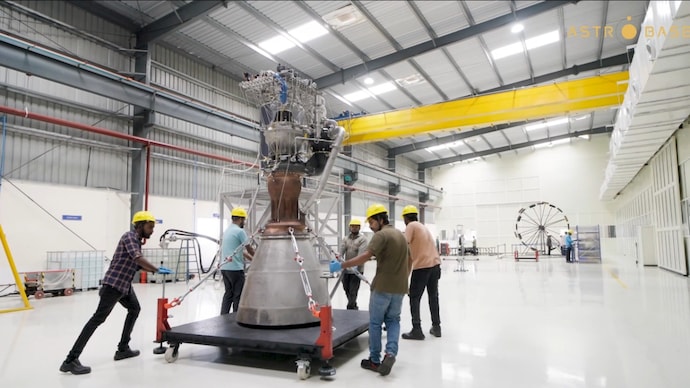
Bengaluru-based startup Astrobase Space Technologies has pulled the covers off EVEREST, an 800-kilonewton liquid rocket engine that the company describes as India's first privately built engine to use the demanding full-flow staged combustion (FFSC) cycle. The unveiling, on 7 August 2026, pushes India's private space sector into propulsion territory that only a handful of engines anywhere in the world have reached.
Why the cycle matters
Most rocket engines burn only a fraction of their propellant in the pumps that feed the main chamber, and vent the rest. Full-flow staged combustion routes both propellants — fuel and oxidiser — through their own preburners before they meet in the combustion chamber, so nearly all of the propellant does useful work. The payoff is higher efficiency and lower thermal stress on turbine components, which in turn makes an engine easier to reuse. The catch is complexity: FFSC is widely regarded as one of the hardest liquid-engine architectures to build, and for decades it existed mostly on test stands. SpaceX's Raptor is the best-known engine to fly the cycle operationally, which is the company EVEREST implicitly measures itself against.
What Astrobase has built
EVEREST is an 80-tonne-class engine producing about 800 kN of thrust, burning liquid oxygen and liquid methane — the "methalox" combination that has become the default for a new generation of reusable vehicles because it burns cleanly and is well suited to being manufactured or eventually sourced off-world. Astrobase quotes a specific impulse of roughly 340 seconds and a throttle range of 50% to 110%, a wide band that lets a booster deep-throttle for a controlled landing and briefly overdrive for launch. The engine is intended for reusable medium-lift launch vehicles rather than small satellite launchers, signalling that Astrobase is aiming at the part of the market where launch cadence and cost per kilogram matter most.
A staged development path
EVEREST is not a paper engine. Astrobase says it ran a sub-scale hot-fire test in September 2025 and completed high-speed turbopump trials in January 2026 — the turbopump being the single most temperamental component in any staged-combustion design. The company now plans a full-scale hot-fire test later this year at a 21.5-acre propulsion test facility it is building in Anantapur, Andhra Pradesh. Owning a dedicated test site is significant in itself: propulsion progress is throttled as much by access to test stands as by engineering, and Indian private firms have historically had to queue for state facilities.
The roadmap
Astrobase has set a maiden orbital flight target of December 2028, with commercial operations to follow. To support a launch business rather than a one-off demonstrator, the company says it intends to stand up manufacturing capacity for up to 50 EVEREST engines a year. It frames this in terms of lift capacity: roughly 100 tonnes of annual launch capacity in a first phase, scaling beyond 1,000 tonnes in a second. Those are ambitious numbers for a company at the engine-unveiling stage, and the 2028 date leaves little margin for the setbacks that staged-combustion programmes almost always encounter.
Where it fits in India's space push
The reveal lands as India's private space ecosystem broadens from launch-vehicle integrators and satellite builders toward the hard, capital-intensive discipline of propulsion. Skyroot has reached orbit, Agnikul has flown a 3D-printed semi-cryogenic engine, and ISRO itself is maturing a 175-tonne-class semi-cryogenic engine for future heavy-lift stages. An indigenous, privately developed FFSC engine — if it survives the leap from turbopump trials to a full-scale hot fire — would add a genuinely frontier capability to that mix. For now, EVEREST is a statement of intent backed by two completed test milestones; the full-scale hot fire expected later in 2026 will be the real measure of whether the cycle's promise translates into Indian hardware.
Sources
- Space-tech startup Astrobase unveils India's first privately built FFSC rocket engine — ThePrint
- Astrobase Unveils India's First Private 800 kN Rocket Engine — GKToday
- India's Private Space Sector Reaches New Heights as Astrobase Unveils First FFSC Rocket Engine 'EVEREST' — Republic World
- Astrobase Unveils India's First 80-Ton 'Everest' FFSC Rocket Engine — Indian Defense News
- India's Private Space Push Gets A New 800 kN Rocket Engine: Meet Astrobase's EVEREST — ETV Bharat