Akash Goes to Central Asia: India Confirms Air-Defence Exports to Tajikistan and Turkmenistan
Defence Secretary Rajesh Kumar Singh has confirmed that India's DRDO-developed Akash air-defence system, first exported to Armenia, has also been supplied to Tajikistan and Turkmenistan, calling it one of India's defence success stories.
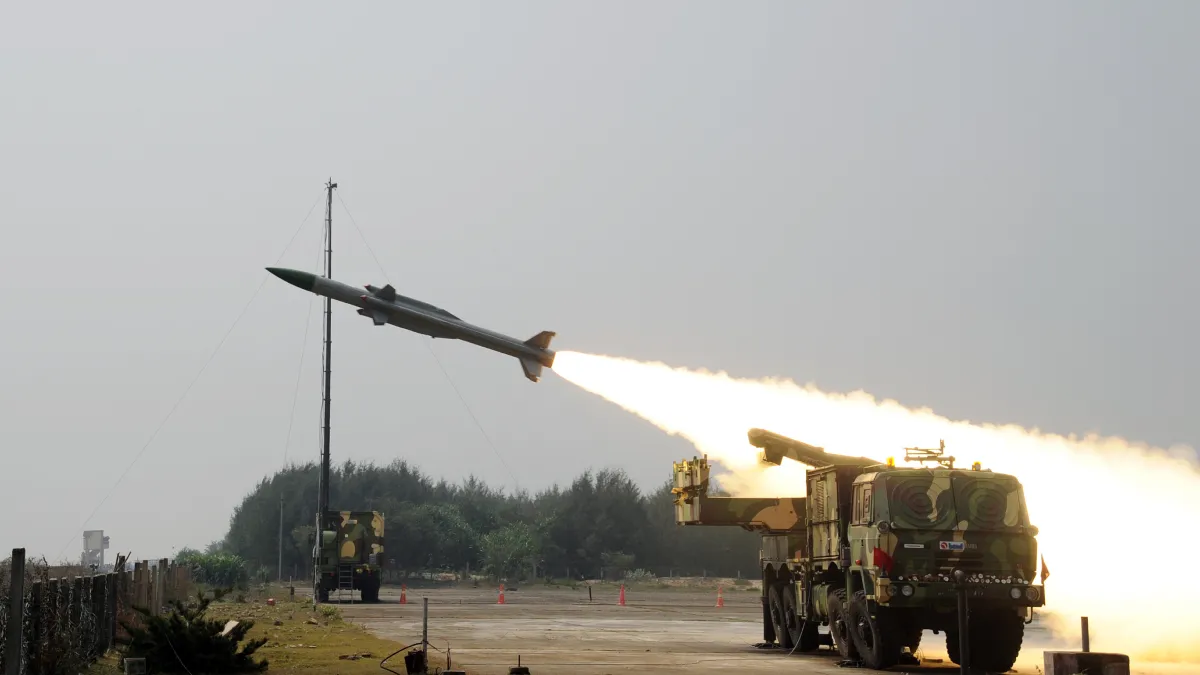
India's home-grown Akash air-defence system now has three foreign operators. Speaking on 1 October 2026, Defence Secretary Rajesh Kumar Singh confirmed that after Armenia, which became the system's first export customer, India has also supplied Akash to Tajikistan and Turkmenistan. He described Akash as a success story reflecting the maturity of Indian missile design and production.
The disclosure matters for more than its headline value. For decades India was one of the world's largest arms importers, and its own missile programmes were judged largely by whether they could meet the needs of the Indian armed forces. Akash crossing into a third export market — and two of them in Central Asia, a region historically supplied by Russia — is a signal that an Indian-designed, Indian-built air-defence system can now compete for customers abroad.
What the Defence Secretary said
According to reports of his remarks carried by ANI and other outlets, Singh made three points about the programme:
- Production has stabilised. The Akash production line is now running steadily, with procurement for the Indian Army and Indian Air Force continuing even as export orders grow.
- Armenia came first. Armenia was the launch export customer and has taken multiple batteries.
- Central Asia followed. India has since exported the system to Tajikistan and Turkmenistan, with further international interest expected.
The ministry has not published the value of the Tajik or Turkmen contracts, the number of batteries involved, or delivery timelines, and this article does not speculate on them.
What Akash actually is
It is easy to think of a missile export as a crate of rockets. Akash is not that. It is a complete short-range surface-to-air missile system: launchers, a fire-control and surveillance radar chain, command-and-control vehicles and the missiles themselves, along with the support infrastructure needed to keep a battery operational. The system was developed by the Defence Research and Development Organisation (DRDO); Bharat Dynamics Limited (BDL) manufactures the missile and Bharat Electronics Limited (BEL) supplies the electronics and associated systems.
The baseline Akash is designed to engage aircraft, helicopters, drones and cruise missiles at short-to-medium ranges using ramjet propulsion. Its successor, Akash-NG (New Generation), adds an indigenous radio-frequency seeker and a new missile; the radar, command-and-control unit and launcher were developed by DRDO laboratories with Indian industry. The baseline export system and Akash-NG are different variants; this export disclosure does not establish exports of Akash-NG.
That combination — a mature system in series production, and a newer variant behind it — is precisely what export customers look for. Buyers want assurance that spares, upgrades and training will be available for decades, which in practice means a production line that the home country's own forces are still using.
Why Central Asia is significant
Tajikistan and Turkmenistan have traditionally relied on Soviet-era and Russian air-defence equipment. As an analytical observation, adding an Indian system can diversify their suppliers and deepen long-term defence relationships; the announcement does not establish the buyers’ reasons.
For India, a foothold in these markets is strategically useful. Air-defence systems create long-term relationships: operators need training, maintenance, spare missiles and eventually mid-life upgrades. Each export therefore anchors a decades-long industrial and diplomatic link.
The bigger export picture
Akash's progress sits inside a wider surge in Indian defence exports. The Ministry of Defence reported that exports reached a record ₹38,424 crore in 2025-26, up from ₹23,622 crore the previous year — an increase of roughly 62%.
Large-ticket systems such as BrahMos and Akash are central to the government's goal of turning that growth into a durable export base rather than a string of one-off sales. They also feed back into the domestic programme: export volumes lengthen production runs, lower unit costs for the Indian armed forces and keep design teams busy on upgrades.
Context: a Defence Secretary pushing for focus
The remarks come during a period in which Singh has been publicly arguing that DRDO should concentrate on a smaller number of strategic, cutting-edge projects and hand more production to industry. Akash is, in many ways, the model he is pointing to: DRDO designed the system and its key technologies, while public and private industry now carry the manufacturing load, including for export.
What to watch next
Three things will show whether Akash's export story keeps growing:
- Akash-NG exports. The newer variant, with its indigenous seeker, would be a more capable and more valuable export product once inducted at home.
- Disclosure of contract values. Clearer numbers on the Central Asian deals would show how much Akash is contributing to the export total.
- Support performance. Export reputations are built on how reliably systems are supported in the field. Timely deliveries, training and spares for Armenia, Tajikistan and Turkmenistan will shape whether others follow.
For the startups and MSMEs that supply sub-systems and components to programmes like Akash, steady export demand also means steadier orders. For India's deep-tech defence ecosystem, the message is clear: a system conceived in Indian laboratories, built by Indian industry and proven with Indian forces is now earning trust abroad.
Sources
- Core announcement or reporting.
- Image and subject source.
- Defence export totals via Outlook Business.
Image: Akash launch image carried by India TV News. File imagery illustrating the system; not a photograph of deliveries to Central Asia. Original source.