Aignosis Raises ₹4 Crore to Take Webcam-Based AI Autism Screening Beyond Rajasthan
Jaipur startup Aignosis, which screens children for autism using a laptop webcam and computer vision, has raised a ₹4 crore seed round backed by Antler, Nikhil Kamath and other investors to expand from Rajasthan's primary health centres to seven more states.
Jaipur-based healthtech startup Aignosis has raised ₹4 crore in a seed round to scale up its AI-assisted autism and developmental screening platform across India. The round was backed by Antler, Zerodha co-founder Nikhil Kamath, IIMA Ventures and angel investors including Varun Dua, according to reporting on 1 October.
The amount is small. What makes Aignosis worth watching is its approach: it screens children for autism with a laptop, a webcam and computer vision, and it is already running inside government primary health centres in Rajasthan.
How the screening works
Founded by Raksheet Jain and Divyansh Mangal, Aignosis is built for children aged 16 months to nine years. The child watches a short video made up of nine stimulus modules on an ordinary laptop. The webcam records how the child responds, and Aignosis's computer-vision models analyse behavioural signals such as:
- Gaze patterns: where and how long the child looks at faces, objects and social scenes.
- Response to name: whether and how quickly the child orients when called.
- Reactions to facial expressions: how the child responds to emotional cues on screen.
The company describes the test as an objective screen that takes around five minutes. It does not replace a clinical diagnosis. It is a first step that flags children who should be referred to a specialist.
The approach builds on decades of research showing that atypical gaze and social attention are among the earliest measurable signs of autism. Eye-tracking studies have used these signals for years, but usually with expensive dedicated hardware in research labs. Aignosis's bet is that a standard webcam and well-trained models can bring a version of that screening to places with no such equipment.
Traction so far
- Over 8,000 screenings completed, according to the company.
- Deployed in more than 20 government primary health centres in Rajasthan, according to the company.
- A "Clinic in Clinic" model, in which the screening runs inside existing clinics rather than standalone centres.
- A target of at least 1 lakh screenings by the end of FY27.
The new money will fund expansion into Punjab, NCR, Haryana, Tamil Nadu, Jharkhand, Karnataka and Maharashtra, with a focus on building screening and referral access across both government and private healthcare networks. The company raised its first round in 2024 from investors including Rajneesh Bhandari and Amit Jain.
Why investors are paying attention
Antler's and Nikhil Kamath's backing reflects a broader trend in Indian health-AI: investors favour startups that plug into existing care pathways rather than build new clinics. The Clinic in Clinic model could reduce the need for standalone premises. A laptop and software are far cheaper to deploy than specialist staff or dedicated eye-tracking rigs. Each new partner clinic or health centre then becomes a new screening point with little extra cost.
Why it matters
Earlier screening can bring families into clinical assessment and support pathways sooner. Yet in India, assessment usually depends on developmental paediatricians, child psychologists and psychiatrists. These specialists are concentrated in large cities, and families elsewhere can wait months or travel long distances to see one.
A low-cost screen that a trained health worker can run at a primary health centre turns that problem around. Children are flagged where they already go for care, and the scarce specialists can focus on the children most likely to need them. That is the same idea India has used in other public-health screening programmes, now applied to neurodevelopment.
The company still has to prove some things. Screening tools must show consistent sensitivity and specificity across languages, cultures and lighting conditions, and across children of very different ages. As Aignosis scales into new states, independent validation and clear referral pathways will matter as much as the AI itself.
Still, for India's health-AI ecosystem, Aignosis is a useful example: a frontier technique from computer vision, packaged to run on everyday hardware and placed inside the public health system rather than beside it.
Sources
Additional accessible reporting: Core report.
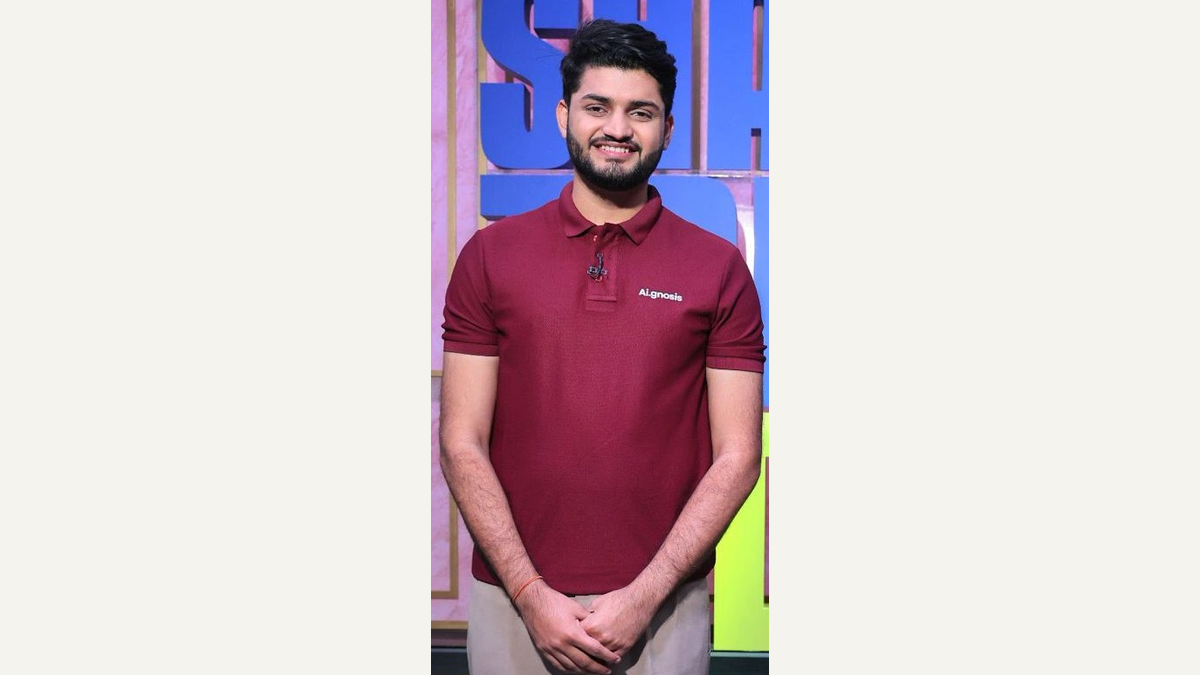
Image: Aignosis. Co-founder Raksheet Jain, from the company website; portrait, not a screening session. Original source.