Agnikul's Four-Engine Cluster Test and the Electric-Pump Bet on Cheap Orbit
Agnikul Cosmos ground-tested a four-Agnilet cluster, using an electric pump-fed cycle to turn thrust-matching into software-defined throttling. With a $500M-plus valuation and ICEYE and Safran MoUs, it de-risks a targeted late-2026 orbital launch.
Manik Gupta
Founder and editor of DeepTech India. Manik writes about India's frontier technology ecosystem — AI, semiconductors, space, quantum, robotics and biotech — translating research and policy into clear, reliable reporting.
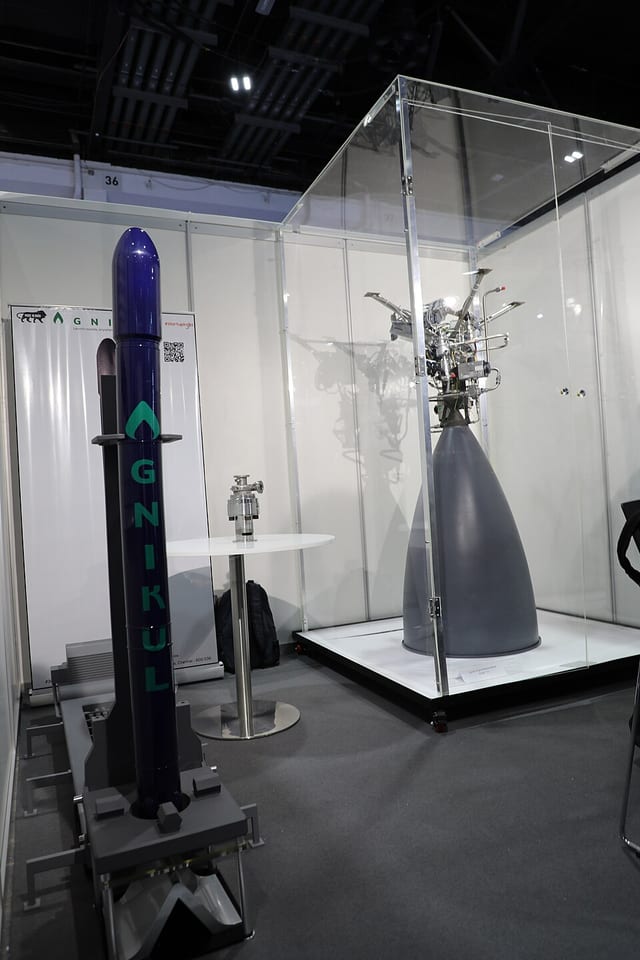
On 19 May 2026, Agnikul Cosmos fired four of its Agnilet semi-cryogenic engines together as a single cluster on the ground — and in doing so cleared the hardest scaling problem in small-launch propulsion. A single engine firing on a test stand is a contained, well-understood event. Four engines bolted to a common thrust structure, igniting and throttling in concert, is a different physics problem entirely. The IIT Madras-incubated startup is betting that an unusual architecture — an electric pump-fed cycle rather than the gas-generator turbopumps that dominate the industry — turns that problem into a software one. If the bet holds, it materially de-risks the company's targeted late-2026 orbital launch of Agnibaan.
Why clustering is the wall small-launch hits
Clustering — strapping multiple smaller engines together rather than building one large one — is how SpaceX got the Falcon 9 to nine Merlins and how Rocket Lab's Electron flies nine Rutherfords. It lets a manufacturer build one engine at volume and scale thrust by adding copies. The catch is that the cluster only works if every engine in it behaves like every other engine, to a tolerance most ground tests never have to confront.
The core failure mode is thrust asymmetry. If one engine in a four-engine aft section produces marginally more thrust than its neighbours, or ignites a fraction of a millisecond out of sequence, the cluster's net thrust vector no longer points through the vehicle's center of mass. The result is an off-axis torque that the flight control system has to null out — and an unsteady one at that. Worse is the coupling between the engines' feed pressure and the airframe's structural modes: a small periodic fluctuation in chamber pressure can drive pogo oscillation, a resonance in which propellant flow, combustion, and the longitudinal flex of the rocket reinforce each other. Left unchecked, pogo and asymmetric torque do not merely degrade performance; they can compromise airframe integrity outright. A sub-millisecond ignition-timing deviation across four chambers is enough to matter.
This is why a four-engine ground test is the meaningful milestone, not a single-engine one. It is the first time Agnikul has shown its engines can be made to behave identically under load — synchronised closely enough to keep thrust balanced across the aft section.
The electric-pump cycle: making throttling a software problem
Every liquid-fuel engine needs to force propellant into the combustion chamber against very high pressure. The conventional answer is a turbopump: a small portion of propellant is burned in a gas generator, and the hot gas spins a turbine that drives the pumps. It is power-dense and proven, but it is also slow to respond — you are commanding combustion to change a turbine's speed — and it is mechanically complex, with the gas generator, turbine, and associated plumbing all operating at extreme temperatures.
Agnikul's Agnilet sidesteps the turbopump. It uses an electric pump-fed cycle: brushless DC motors, drawing from onboard batteries, drive the propellant pumps directly. Across the four-engine cluster, that means 8 high-discharge brushless DC motors, 8 independent propellant pumps, and 8 speed-control algorithms — a motor-and-pump pair per propellant, per engine, each governed by its own controller. (Each engine feeds two propellants, kerosene and oxidiser, hence eight of everything for four engines.)
The payoff is control authority. Because pump output is set by motor RPM, and motor RPM is an electrical command rather than a combustion event, the cluster can adjust each engine's propellant flow on microsecond timescales. Agnikul calls this software-defined throttling: the eight speed-control loops trim pump RPM in real time to keep thrust balanced across the aft section, actively cancelling the asymmetries that would otherwise build into torque or pogo. A turbopump engine cannot do this — its response time is bounded by thermodynamics. An electric cluster's response is bounded by how fast its controllers and motor drives can act, which is far faster. Thrust matching, the thing clustering lives or dies on, becomes a tuning problem in firmware rather than a manufacturing-tolerance problem in hardware.
The trade-off is honest and worth stating: electric pumps carry battery mass, and the batteries are largely dead weight once depleted. That mass penalty is why electric-pump cycles have historically been confined to smaller stages, where the simplicity and control benefits outweigh the weight — exactly Agnikul's segment.
Printed in one piece, fed by semi-cryo
Each Agnilet produces 6.2 kN of thrust and is 3D-printed as a single continuous piece of Inconel, a nickel-based superalloy chosen for its strength at high temperature. Printing the engine monolithically eliminates the hundreds of welds, joints, and fasteners a conventionally manufactured engine requires — every one of them a potential leak path and a stress concentration. Removing them improves thermal and mechanical durability and collapses both part count and assembly time. It also means far fewer process steps in which to introduce unit-to-unit variation. For a clustering strategy that demands engine-to-engine consistency, single-piece printing and the electric cycle are complementary: one narrows the spread in the hardware, the other corrects what spread remains in software.
The propellant choice reinforces the cost logic. Agnilet burns aviation-grade kerosene with sub-cooled liquid oxygen — a semi-cryogenic combination. Sub-cooling the LOX below its boiling point increases its density, packing more oxidiser into a given tank volume. Compared with hypergolic propellants (toxic, corrosive, expensive to handle) or liquid hydrogen (deeply cryogenic, low-density, demanding insulation and infrastructure), kerosene/LOX needs far simpler ground support. Cheaper handling and cheaper pad infrastructure feed directly into a lower cost per launch.
Agnibaan itself is designed around the cluster. Its modular "native scaling" uses four to seven first-stage engines depending on payload mass — the same engine, in different counts, sized to the mission. That is the commercial expression of clustering: one qualified engine, a configurable rocket.
Unit economics, the moat, and the risks
Agnikul's pitch into the addressable market rests on a real gap. Most small payloads today reach orbit via rideshare, hitching onto a larger launch — cheap per kilogram but rigid, going to whatever orbit and schedule the primary payload dictates. For operators who need a specific orbital plane, altitude, or timing — Earth-observation and communications constellations chief among them — that inflexibility is a real cost. Dedicated small-launch is the premium product that sells against it, and the TAM Agnikul is underwriting with software-defined, native-scaling launch.
The capital base is substantial for the segment. The cluster work is built on a $26.7M Series B raised in late 2023, plus ₹25 crore from Tamil Nadu's TIDCO in early 2026; the company's post-money valuation surpassed $500M in Q2 2026. The commercial signals are now arriving alongside the technical ones. At Bharat Innovates 2026 in Nice (14–16 June), Agnikul signed MoUs — routed through IITM Global — with Finland's ICEYE, a leader in synthetic-aperture-radar constellations and a plausible anchor launch customer, and France's Safran, a tier-1 propulsion and defense supplier. Those agreements form part of IIT Madras's roughly $100M value-creation pipeline surfaced at the event, and they hint at where the moat could deepen: a domestic engine maker plugged into European constellation operators and tier-1 aerospace.
The honest caveats remain. A successful ground test is necessary, not sufficient — flight subjects the same hardware to aerodynamic loads, structural flex, and an ascent thermal environment the stand cannot replicate. The electric-pump weight penalty caps how far up the payload curve the architecture scales. And dedicated small-launch is crowded internationally, with several well-funded entrants chasing the same constellation customers. Per Fortune India (31 May 2026), the four-engine test is the gate Agnikul needed to clear; India Blooms (16 June 2026) and the company's own disclosures frame the Nice MoUs as the commercial complement. CEO Srinath Ravichandran's company has now shown the engineering and lined up the demand. The remaining question — the one that always decides launch — is whether the cluster that balanced itself on the ground does the same on the way to orbit.
Tags
More from Space Technology
U-Space and AXISCADES Sign Cooperation Deal to Explore India's Microsatellite Market
French space company U-Space and Bengaluru's AXISCADES have signed a commercial cooperation agreement to jointly pursue India's microsatellite market, one of three India-France private space deals struck at the Paris International Space Summit.
RIDE! Targets Q3 2028 Launches for Two TakeMe2Space Satellites
The launch-services agreement covers mission management for two spacecraft in the Hyderabad company’s planned orbital-computing constellation. It is a future deployment commitment, not evidence that the network is operating.