TCS and NVIDIA Open a Bengaluru Lab to Drag Industrial AI Out of Pilot Purgatory
TCS opened the Autonomous Engineering Lab, Powered by NVIDIA, in Bengaluru on 15 July 2026 — billed as India's first 'physical AI' hub, built to move industrial-AI and autonomous-mobility projects from pilots into production.
Manik Gupta
Founder and editor of DeepTech India. Manik writes about India's frontier technology ecosystem — AI, semiconductors, space, quantum, robotics and biotech — translating research and policy into clear, reliable reporting.
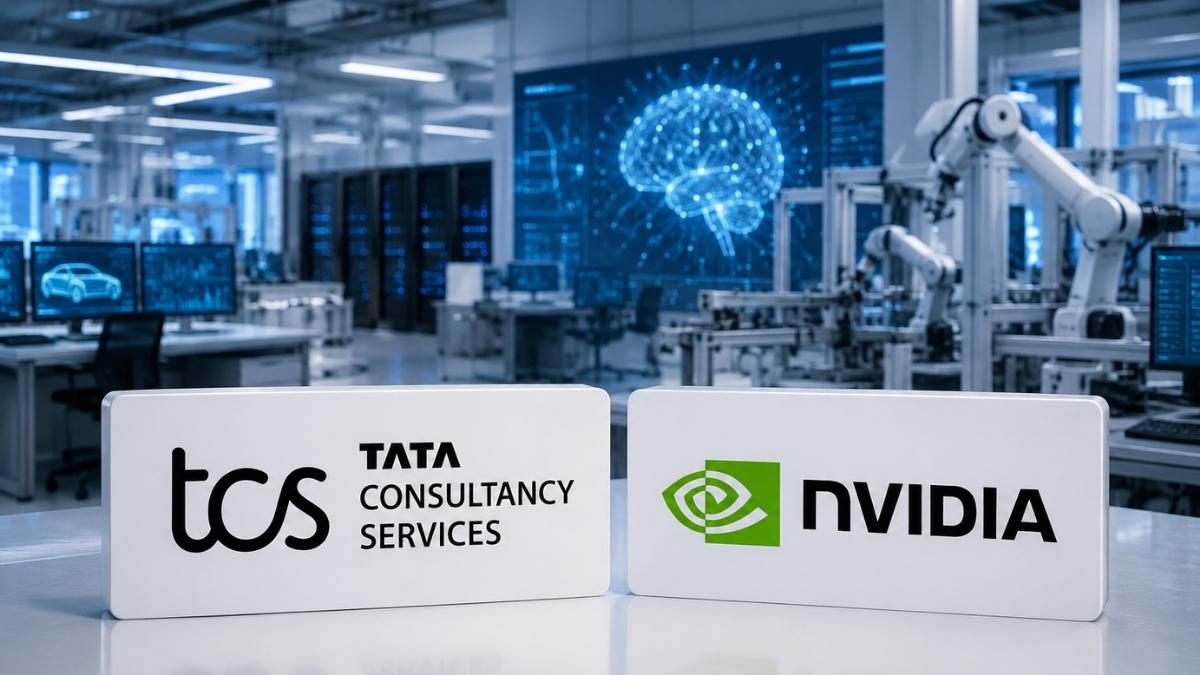
Tata Consultancy Services opened a new facility in Bengaluru on 15 July 2026 aimed squarely at one of enterprise AI's most stubborn problems: the gap between a promising pilot and a system that actually runs a factory or a fleet. Called the TCS Autonomous Engineering Lab, Powered by NVIDIA, and housed at the company's Global Axis campus, TCS is positioning it as India's first dedicated hub for "physical AI" — artificial intelligence that has to act in the real world of machines, vehicles and production lines rather than just generate text on a screen.
The pilot-to-production gap
Most industrial AI never leaves the demo stage. A manufacturer will prove that a vision model can spot defects on one line, or that an autonomous-driving stack works on a test track, and then stall — unable to validate the system across the messy variety of real operations, integrate it with existing equipment, or trust it enough to hand over control. TCS's pitch for the lab is that it exists to close exactly that gap, giving enterprises a place to design, test and validate industrial-AI systems and move them from pilots to production-scale deployment.
The approach leans heavily on simulation. Rather than risk expensive equipment or downtime, customers can prototype and stress-test use cases in digital environments first — building digital twins of a plant or a vehicle, running scenarios against them, and only then deploying into the physical world of mobility, manufacturing and industrial operations.
What is inside
TCS says the lab brings together several strands of its AI work on top of NVIDIA's accelerated-computing infrastructure. Among the capabilities it is showcasing are TCS DriveSphere, a connected, AI-led platform for mobility and autonomous systems; a set of physical-AI and smart-manufacturing use cases; agentic AI and vision-AI solutions; and digital-twin and simulation environments where all of it can be modelled before it ships.
The common thread is autonomy in physical settings — cars and industrial vehicles that perceive and decide, production lines that adapt, and AI agents that carry out multi-step engineering tasks rather than simply answering questions. That framing reflects a broader industry pivot, championed loudly by NVIDIA, toward "physical AI" and robotics as the next frontier after generative text and images.
Why it lands in Bengaluru
The choice of location is not incidental. India is one of the world's largest hubs for outsourced engineering and R&D, and TCS is one of its largest employers of that talent. A physical-AI lab that pairs the company's domain expertise in automotive, manufacturing and industrial engineering with NVIDIA's hardware is an attempt to move Indian services firms up the value chain — from writing software for global clients toward designing and validating the autonomous systems those clients will run.
The lab also builds on a long-running relationship between the two companies in AI and accelerated computing. TCS frames the Bengaluru facility as a new, more concrete phase of that partnership: less about research demonstrations and more about scaled deployment, client engagement and measurable impact across industries worldwide.
The test ahead
For all the capability on display, the lab's value will be judged by outcomes that take time to appear — how many client pilots it actually pushes into production, and whether "physical AI" proves as transformative on real factory floors as its backers claim. Industrial AI has a long history of impressive demonstrations that never scale, and a lab, however well-equipped, does not by itself change that.
What TCS and NVIDIA are betting is that the missing ingredient has been a place to do the unglamorous work of validation and integration — and that building one in India, close to both the engineering talent and the manufacturers, is the way to turn stalled pilots into deployed systems. For a services giant looking to define its role in the AI era, that is as much a strategic statement as a technical one.
Sources
Tags
More from Artificial Intelligence
AMD Partners With Delhi University to Train 10,000 Students in AI and ROCm
AMD has signed an MoU with the University of Delhi to train about 10,000 students on its open-source ROCm AI platform over the next year, extending its push to build developer loyalty in India.
Adobe Acquires Rilo, an IIT Bombay-Founded AI Agents Startup, Less Than a Year After Launch
Adobe has acquired Bengaluru-founded AI agents startup Rilo, less than a year after two IIT Bombay alumni launched it, in a deal that folds Rilo's six-person team and technology into Adobe's marketing suite.