India's Grid Finds Its Long-Duration Backbone: SECI Awards 1,344 MW of Pumped Storage
In an electronic reverse auction, SECI has awarded 1,344 MW of pumped hydro storage — out of 1,500 MW / 12,000 MWh tendered — to Greenko (720 MW), Tata Power (324 MW) and Torrent (300 MW), a milestone that pushes India's long-duration energy storage from policy ambition into bankable contracts.
Manik Gupta
Founder and editor of DeepTech India. Manik writes about India's frontier technology ecosystem — AI, semiconductors, space, quantum, robotics and biotech — translating research and policy into clear, reliable reporting.
India's effort to store renewable power for hours rather than minutes crossed an important line in late July 2026, when the Solar Energy Corporation of India (SECI) announced the results of a competitive auction for large-scale pumped hydro storage. Of the 1,500 MW / 12,000 MWh the agency had put out to tender, contracts for 1,344 MW went to three of the country's biggest clean-energy developers, following an electronic reverse auction held on 9 July.
It is a technical, unglamorous milestone — no ribbon-cutting, no new gadget — but it is exactly the kind of contracting that decides whether India's vast solar and wind build-out can actually keep the lights on after sundown.
Who won what
Greenko Energies emerged as the largest winner, taking its entire quoted capacity of 720 MW. Torrent Energy Storage Solutions secured its full 300 MW. Tata Power was awarded 324 MW — a partial allocation against an original bid of 660 MW — tied to a project in Maharashtra. The winning offers clustered tightly at an equivalent total storage cost of roughly ₹1.35 crore per MW per year, and the projects are underpinned by 40-year Pumped Storage Purchase agreements. Developers are expected to commission the plants by 2029.
Why pumped hydro, and why now
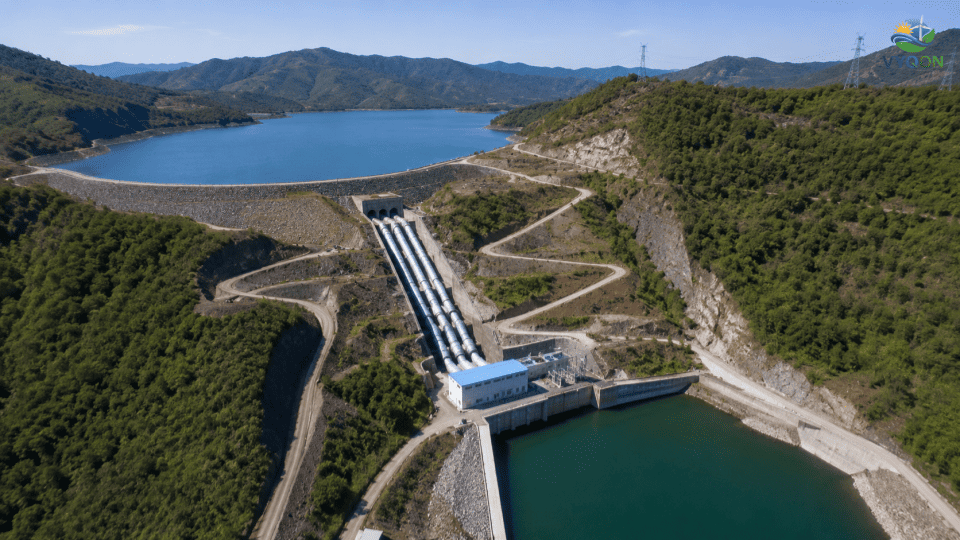
Pumped storage hydropower is often called the world's biggest battery, and the description is close to literal. Two reservoirs are built at different heights; when power is cheap and plentiful — the middle of a sunny, windy day — surplus electricity pumps water uphill. When demand peaks in the evening, that water is released back down through turbines to regenerate electricity. Unlike a lithium-ion battery, a pumped storage plant can discharge for eight, ten or twelve hours at a stretch, which is why it sits in the category planners call long-duration energy storage, or LDES.
India needs that duration badly. The country has been adding solar capacity at record pace, but solar generation collapses precisely when household demand surges after dark — the mismatch grid engineers know as the "duck curve." Short-duration batteries can smooth minutes and hours; shifting bulk energy from midday to late evening, day after day, is a job suited to pumped hydro. The 12,000 MWh of storage energy behind this tender is the metric that matters most: it is the reservoir of shifted power, not just the instantaneous output, that firms up a renewable grid.
Part of a wider storage push
The pumped-hydro awards did not arrive in isolation. The same LDES drive has also seen India sanction its first utility-scale flow-battery installation, signalling that policymakers want a portfolio of long-duration technologies rather than a single bet. Pumped hydro remains the cheapest and most mature option at gigawatt-hour scale, but it is geographically constrained — it needs the right terrain and water — so newer chemistries are being seeded alongside it to cover sites where reservoirs are impractical.
For the winning developers, the contracts convert long-discussed ambitions into bankable projects. Greenko has built its business around integrated renewable-plus-storage assets; Tata Power and Torrent are both racing to add storage to sprawling generation portfolios. Forty-year purchase agreements give them the revenue certainty that pumped-storage projects, with their heavy up-front civil-engineering costs and long build times, badly need.
What it signals
The significance of the SECI auction is less about any single reservoir and more about a market coming of age. For years, India's pumped-storage pipeline existed mostly on paper — announced megawatts, memoranda, policy targets. A competitive, tariff-discovered award to three credible developers, with firm capacity and a commissioning deadline, is the point at which long-duration storage stops being a slide in a presentation and starts being a line item on the grid. If the 2029 timelines hold, the projects will begin absorbing daytime solar and releasing it into India's evening peak just as the country's renewable capacity reaches a scale that makes such shifting indispensable.
Sources
- SolarQuarter — SECI awards 1,344 MW pumped storage capacity to Greenko, Tata Power and Torrent
- Energy-Storage.news — India awards long-duration energy storage contracts for 1,344 MW pumped hydro, utility-scale flow battery
- Business Standard — Tata Power wins LoA from SECI to supply 324 MW from Maharashtra project
- Renewable Watch — SECI announces results of 1,500 MW PSP auction
Tags
More from Energy Tech
Magna Doubles Down on Yuma Energy With $35 Million to Scale India's Battery-Swapping Network
Automotive supplier Magna International has put a further $35 million into Yuma Energy, the battery-swapping venture it co-founded with Yulu, to expand the network past 60 million swaps.
India Weighs a ₹13,000 Crore Push to Build the Battery Materials It Still Imports From China
A proposed incentive scheme would target anode, cathode, electrolyte, separator and copper-foil manufacturing — the upstream layer India's battery gigafactories still depend on Chinese suppliers for.