
IN-SPACe Puts the PSLV — and the LVM3 — Up for Private Technology Transfer
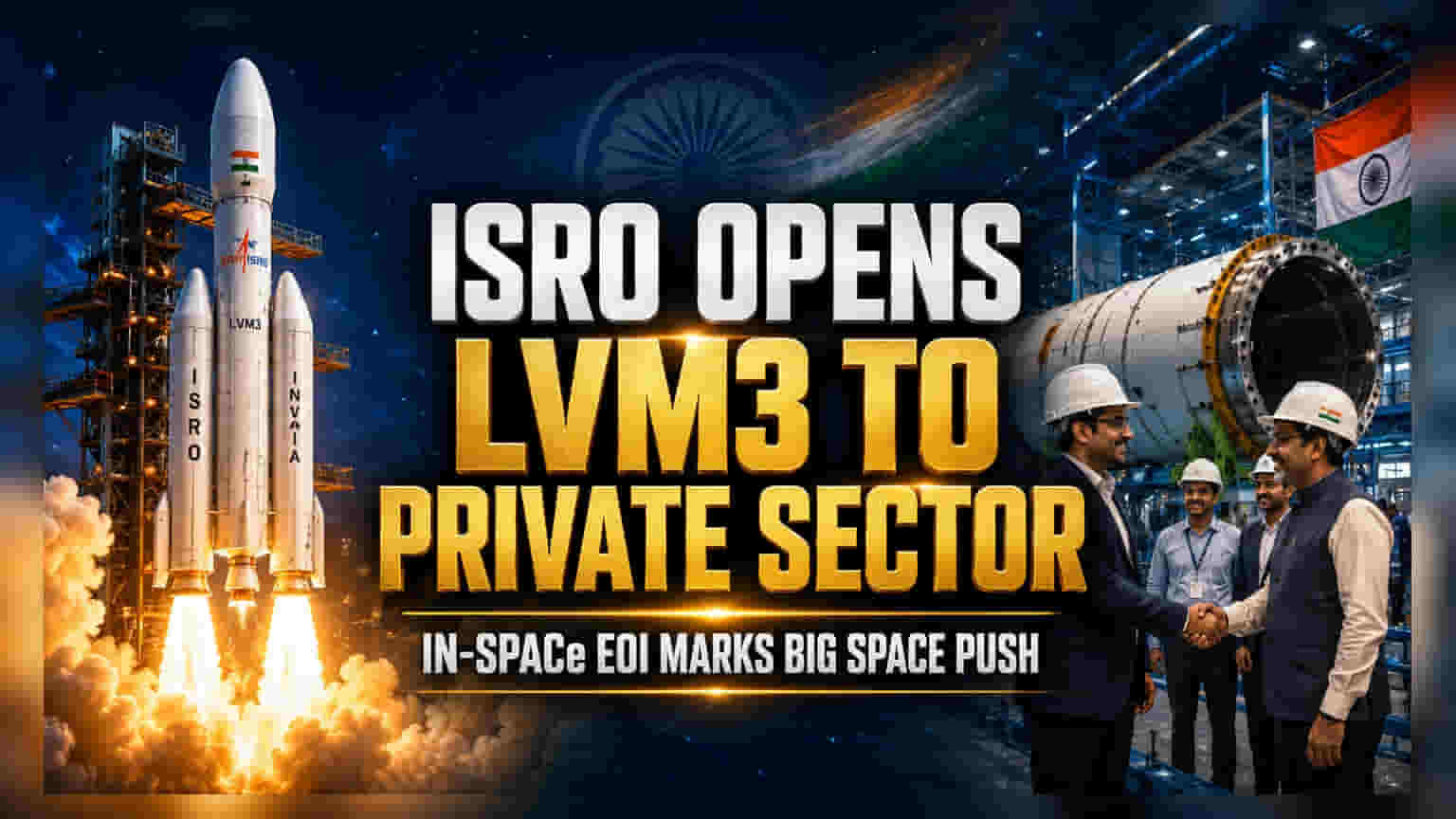
IN-SPACe has issued Expressions of Interest to transfer full technology for ISRO's PSLV — and, for the first time, the heavy-lift LVM3 — to majority Indian-owned private firms, with ISRO hand-holding for 30 to 42 months. The move aims to free ISRO for Gaganyaan and deep space while industry runs operational launches.
"We Have Released an Expression of Interest"
India has invited private industry to take over its workhorse rocket. On 23 June 2026, IN-SPACe — the Indian National Space Promotion and Authorisation Centre, the Department of Space's single-window regulator for private players — confirmed it had issued an Expression of Interest (EoI) for the full transfer of technology of the Polar Satellite Launch Vehicle (PSLV), the country's most flight-proven orbital rocket.
"We have released an expression of interest to transfer the technology of the PSLV rocket to the private sector," IN-SPACe Chairman Pawan Goenka said, adding that only companies "majority owned and controlled by Indians" would qualify. Goenka said major industrial groups were already showing interest, but declined to name them.
It is a genuinely significant step. Rather than simply contracting industry to build sub-systems, the state is offering to hand over the know-how to manufacture and operate an entire launch vehicle — a model India has experimented with before (notably an earlier PSLV production arrangement with a HAL–L&T consortium and an SSLV transfer to HAL) but is now pushing further and opening up more broadly.
The Terms
The EoI sets a high bar, signalling that IN-SPACe wants serious, well-capitalised takers rather than early-stage startups acting alone. According to the criteria reported across Indian business press, an eligible applicant must be majority-owned and controlled by Indian citizens; the company, or at least one consortium member, must have at least five years of experience in the space or aerospace domain; and the applicant must show an annual turnover above ₹400 crore in any three of the last five years, or a valuation of at least ₹1,000 crore.
In return, IN-SPACe and ISRO will provide infrastructure and hand-holding support for 30 months, or until the selected party realises and launches two PSLV vehicles — whichever comes first. The intent is a clean transfer: at the end of the period, a private entity should be able to build and fly the PSLV largely on its own.
The LVM3 Goes Too
The PSLV is not the only vehicle on offer. IN-SPACe has also moved to open ISRO's heavy-lift LVM3 — the "Bahubali" rocket that launched Chandrayaan-3 — to end-to-end private realisation for the first time, inviting industry to acquire and operationalise its manufacturing, launch operations and commercialisation. For the larger, more complex LVM3, the proposed hand-holding window is longer: up to 42 months, or until two successful launches.
Taken together, the two EoIs amount to India putting its principal operational launchers — one medium-class, one heavy — into private hands within the same window.
The Strategy: ISRO Steps Back From the Assembly Line
The logic is one of division of labour. If private companies can manufacture and fly PSLV and LVM3 missions, ISRO can redirect scarce engineering capacity toward the things only a national agency tends to do: human spaceflight via Gaganyaan, the planned Bharatiya Antariksh Station, next-generation and reusable launch vehicles, and deep-space science. It also addresses a hard commercial constraint — launch cadence. India's share of the global launch market has long been capped less by capability than by how many rockets it can build and fly each year; a private production line is the most direct way to raise that ceiling and chase the booming small- and medium-satellite launch demand.
The move sits squarely within the Indian Space Policy 2023, which formalised IN-SPACe's mandate to hand non-strategic activity to non-governmental entities, and it builds on the 2019–2020 opening that seeded hundreds of Indian space startups.
What to Watch
The eligibility thresholds are the story's tension. A ₹400-crore-turnover or ₹1,000-crore-valuation bar effectively narrows the field to large industrial houses or well-funded consortia, which may push smaller space startups into junior roles rather than prime contractors. The other open questions are execution and timeline: whether a private entity can genuinely absorb a full launch-vehicle stack inside 30 to 42 months, how the EoIs convert into binding agreements, and which "major industrial groups" Goenka had in mind actually step forward.
Sources
- India to Share Rocket Tech to Hasten Development of Space Firms — Bloomberg
- Govt to share rocket technology to hasten development of local space firms — Business Standard
- India to Open PSLV Rocket Technology to Private Space Companies — Orbital Today
- IN-SPACe Offers Full Technology Transfer Of PSLV To Indian Private Industry — Free Press Journal
- India Opens Heavy-Lift Rocket LVM3 to Private Sector for First Time — IndianWeb2
- Private Industry Invited To Build And Operate ISRO's LVM-3 Rocket — Indian Defence News