BatX Energies Raises Rs 105 Crore to Mine Critical Minerals From Dead Batteries
Gurugram's BatX Energies has raised Rs 105 crore in a Series A led by IvyCap Ventures to scale its recovery of lithium, cobalt, nickel and graphite from dead batteries and scrap — an urban-mining bet on cutting India's dependence on imported battery materials.
Gurugram-based BatX Energies has raised Rs 105 crore (about $11-12 million) in a Series A round led by IvyCap Ventures, in one of the week's most consequential clean-energy deep-tech deals. The raise is a bet on a problem India cannot subsidise its way around: the country wants a battery-manufacturing base, but it does not control the lithium, cobalt, nickel and graphite that batteries are made of.
The deal
The round was led by IvyCap Ventures, with participation from existing backers including Zephyr Peacock, the Mankind Pharma Family Office, the Excel Industries Family Office, and JITO (the Jain International Trade Organisation angel platform). It follows a $5 million pre-Series A round led by Zephyr Peacock in December 2023, and reflects rising investor conviction in the battery circular economy.
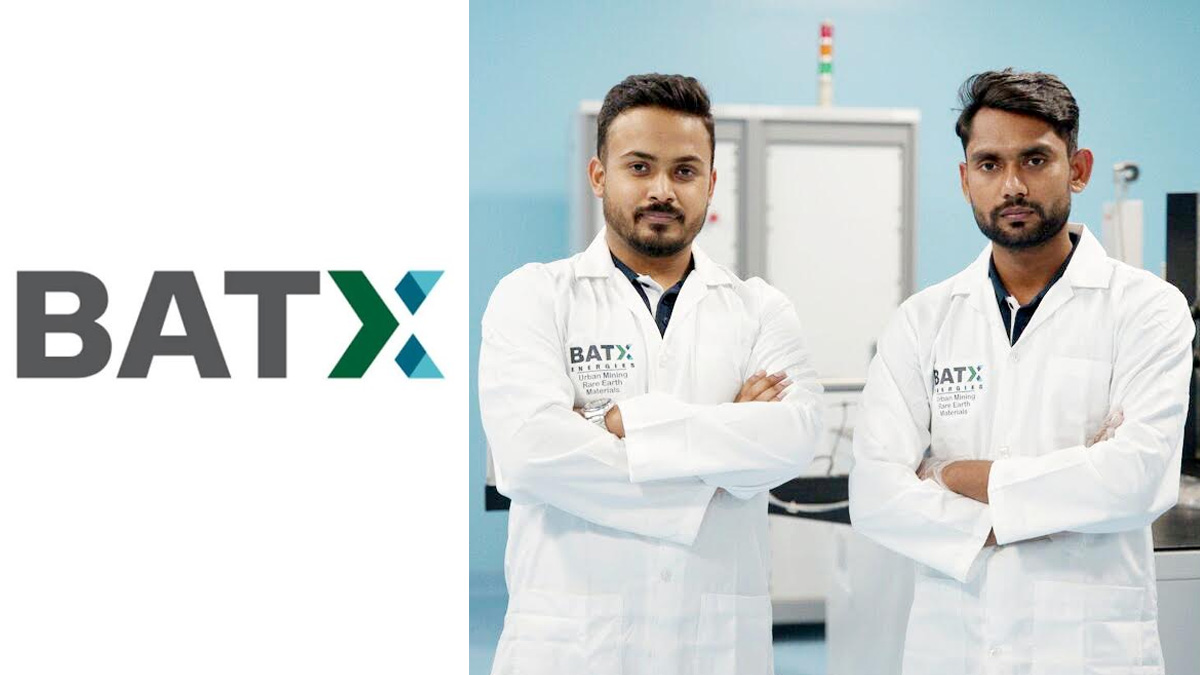
Founded by Utkarsh Singh and Vikrant Singh, BatX will use the fresh capital to expand its recycling and refining capacity, strengthen its research and development, and accelerate the build-out of a domestic supply chain for battery materials.
Urban mining, not imported ore
BatX operates at the recovery-and-refining end of the battery value chain. It takes end-of-life batteries and manufacturing scrap and pulls back out the materials that matter most: lithium, cobalt, nickel and graphite. In effect, it treats the growing mountain of spent cells as an ore body, an approach often called urban mining, and refines the recovered black mass into battery-grade inputs that can re-enter the manufacturing loop.
The strategic logic is straightforward. India is scaling cell manufacturing rapidly through gigafactory investments and production-linked incentives, but the critical minerals feeding those lines are concentrated in a handful of countries and refined overwhelmingly in China. Every kilogram of lithium or cobalt recovered domestically from a dead battery is a kilogram that does not have to be imported, and it arrives without the geopolitical strings attached to primary mining.
Why it fits India's moment
The timing lines up with a broader national push. India's National Critical Minerals Mission has made securing and recycling strategic minerals an explicit policy priority, and recyclers like BatX sit squarely inside that agenda. As the first wave of electric vehicles, grid storage systems and consumer electronics reaches end of life over the coming years, the volume of recoverable material will only grow, turning today's waste stream into tomorrow's feedstock.
The challenge for any recycler is scale and yield: recovery has to be efficient enough, and volumes large enough, to compete with primary supply on cost. That is exactly where the new capital is aimed, at expanding capacity and sharpening the refining process. If BatX can industrialise high-purity recovery at scale, it addresses one of the least glamorous but most decisive constraints on India's energy-storage ambitions: not the cells, but the materials inside them.
Sources
- Entrackr: https://entrackr.com/news/batx-energies-raises-rs-105-cr-in-series-a-round-led-by-ivycap-ventures-12125741
- Inc42: https://inc42.com/buzz/battery-tech-startup-batx-energies-nets-105-cr-to-bolster-rd/
- EVReporter: https://evreporter.com/batx-energies-raises-105-crore-in-series-a-funding/
- DealStreetAsia: https://www.dealstreetasia.com/stories/ivycap-batx-energies-487672