Two BITS Pilani Students Raise ₹4 Crore for Nightshade, a 600 km/h Jet-Powered Strike Drone
Apollyon Dynamics, founded by two BITS Pilani Hyderabad students, has raised ₹4 crore led by Naandi Ventures — with Skyroot, Dhruva Space and Agnikul joining — to develop Nightshade, a jet-powered strike drone that flies at 600–700 km/h.
Manik Gupta
Founder and editor of DeepTech India. Manik writes about India's frontier technology ecosystem — AI, semiconductors, space, quantum, robotics and biotech — translating research and policy into clear, reliable reporting.
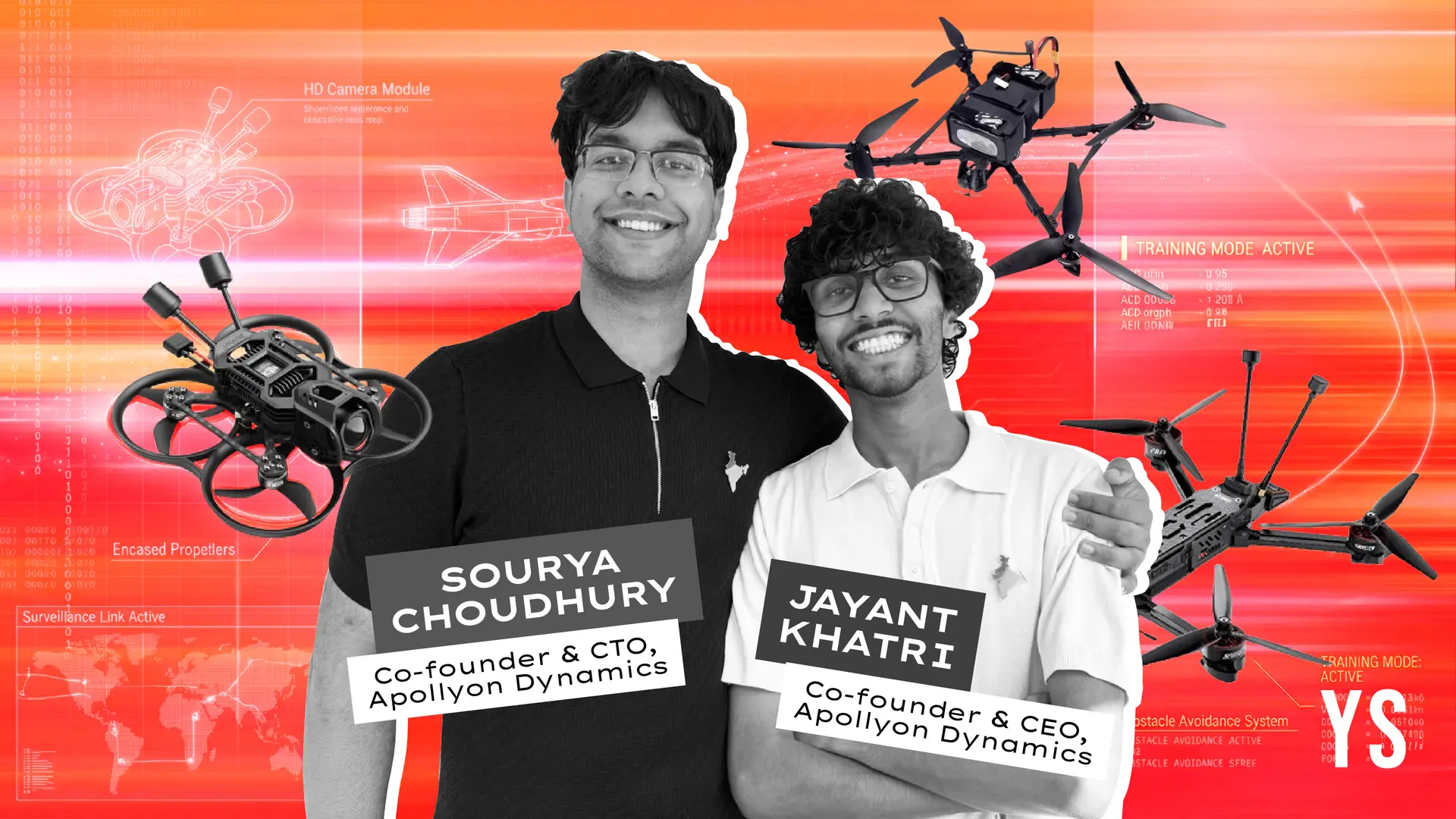
Apollyon Dynamics, a defence-technology startup that began in a hostel room at BITS Pilani's Hyderabad campus, has raised ₹4 crore in a pre-seed round led by Naandi Ventures. The round values the two-year-old company at about ₹25 crore — and its cap table reads like a who's who of India's spacetech scene, with Skyroot Aerospace, Dhruva Space and Agnikul Cosmos all writing cheques.
The founders, Jayant Khatri and Sourya Choudhury, are both 21. What they are building is not a hobbyist quadcopter but a jet-powered strike drone designed to fly faster than almost anything else in the Indian startup ecosystem.
From a hostel room to a strike drone
Apollyon was incubated on the BITS Pilani Hyderabad campus, and the two founders have leaned into the origin story of starting the company while still students. That framing matters less than what they have actually flown: the team says it has already test-launched a jet-powered unmanned aerial vehicle from a moving vehicle, demonstrating the kind of mobile launch capability that a battlefield system would need.
The fresh capital, the founders say, will go toward research, manufacturing infrastructure and scaling up production of their flagship platform.
What Nightshade is built to do
The product is the Nightshade ADX-1, a jet-class unmanned aerial vehicle with reported cruising and attack speeds of 600 to 700 km/h. It has a maximum take-off weight of about 70 kg and can carry modular payloads, including up to 5 kg of explosives for precision strike missions.
The intended role is one of the more demanding in modern air warfare: Suppression of Enemy Air Defences, or SEAD — the job of locating and knocking out hostile radar and air-defence systems before larger, crewed aircraft go in. The company has also emphasised operation in GPS-denied environments, where satellite navigation is jammed or spoofed, a condition that has become the norm in contested airspace.
That positioning is deliberate. Most of the drones India's startups have fielded so far are slow, propeller-driven surveillance or short-range attack platforms. A high-speed, jet-powered vehicle aimed at SEAD is a step up in both engineering difficulty and strategic value, and it slots into a category — fast, expendable, hard-to-intercept strike drones — that the war in Ukraine has pushed to the top of every military's shopping list.
An unusual cap table
The most striking feature of the round is who joined it. Skyroot Aerospace, Dhruva Space and Agnikul Cosmos are three of the best-known names in India's private space sector, and all three are Hyderabad-anchored. Their participation in a defence-drone pre-seed is a signal of how tightly the city's deep-tech founders now back one another, and of how blurred the line between space and defence propulsion has become.
Lead investor Naandi Ventures set the ₹25-crore valuation. For a company at this stage, with hardware still in the prototype-and-test phase, the round is small in absolute terms — but pre-seed cheques for jet-propulsion hardware are rare anywhere, and rarer still for a founding team barely out of undergraduate coursework.
A crowded, fast-moving field
Apollyon is entering a segment that is suddenly busy. Established players such as Zen Technologies and Paras Defence are winning Ministry of Defence contracts for counter-drone and anti-drone systems, while startups routed through the iDEX programme — Big Bang Boom Solutions among them — have landed orders worth hundreds of crores. The government's procurement machinery has swung firmly toward indigenous unmanned systems, and analysts peg the domestic addressable market for these platforms in the thousands of crores over the next five years.
The challenge for a young team is the gap between a promising prototype and a qualified, mass-produced weapon system. Jet propulsion is unforgiving; airworthiness, reliability and the trials that precede any military order are measured in years, not funding rounds. Apollyon's ₹4 crore buys it runway to keep testing, not a place in the order book.
Still, the pitch is a clear one: a fast, cheap, indigenous strike drone built for exactly the missions India's forces are now prioritising, backed by founders and investors who have watched the country's space startups go from campus projects to unicorns in under a decade. Whether Nightshade can make the same leap is the open question — but it is now a funded one.
Sources
- Business Today — A drone flying at 600 km/h? This Hyderabad startup wants to redefine aerial warfare
- Deccan Chronicle — Nightshade ADX-1: 600 kmph jet-class drone built for GPS-denied missions
- Hyderabad Mail — Hyderabad defence startup raises ₹4 crore after Army drone deal
- IDRW — New jet-powered UAV prototype tested by Apollyon Dynamics
Tags
More from DefenceTech
DRDO Invites Bids for an Indigenous Air-to-Air Refuelling Pod, Targeting a Gap Russian Tankers Can't Fill
DRDO has opened bidding under its Technology Development Fund for an indigenous, modular Air-to-Air Refuelling Pod, aiming to reduce the Air Force's dependence on its serviceability-plagued Il-78 tanker fleet.
Bharat Forge's Kalyani Strategic Systems Signs With Thales to Build 70mm Rockets in India
KSSL, the defence arm of Bharat Forge, has signed a strategic alliance with Belgium's Thales to locally produce combat-proven 70mm rocket systems, part of a ten-agreement India-Belgium defence package signed during a state visit.